
The pace of change in the world of artificial intelligence is speeding up, and along with it is a paradigm shift in the way organizations build and operate computing infrastructure. In the past, AI teams concerned themselves only with building models; today, however, these teams are fundamentally rethinking the hardware and platforms needed to run those models. In addition, the volume and complexity of workloads have increased, and infrastructure built today cannot support that kind of scaling.
This shift has led many organizations to adopt advanced GPU-powered environments capable of supporting large-scale AI training, inference, and data processing. One of the enabling technologies is the NVIDIA H200 GPU, which has become an indispensable part for teams working on better performance, quicker model development, and more scalability.
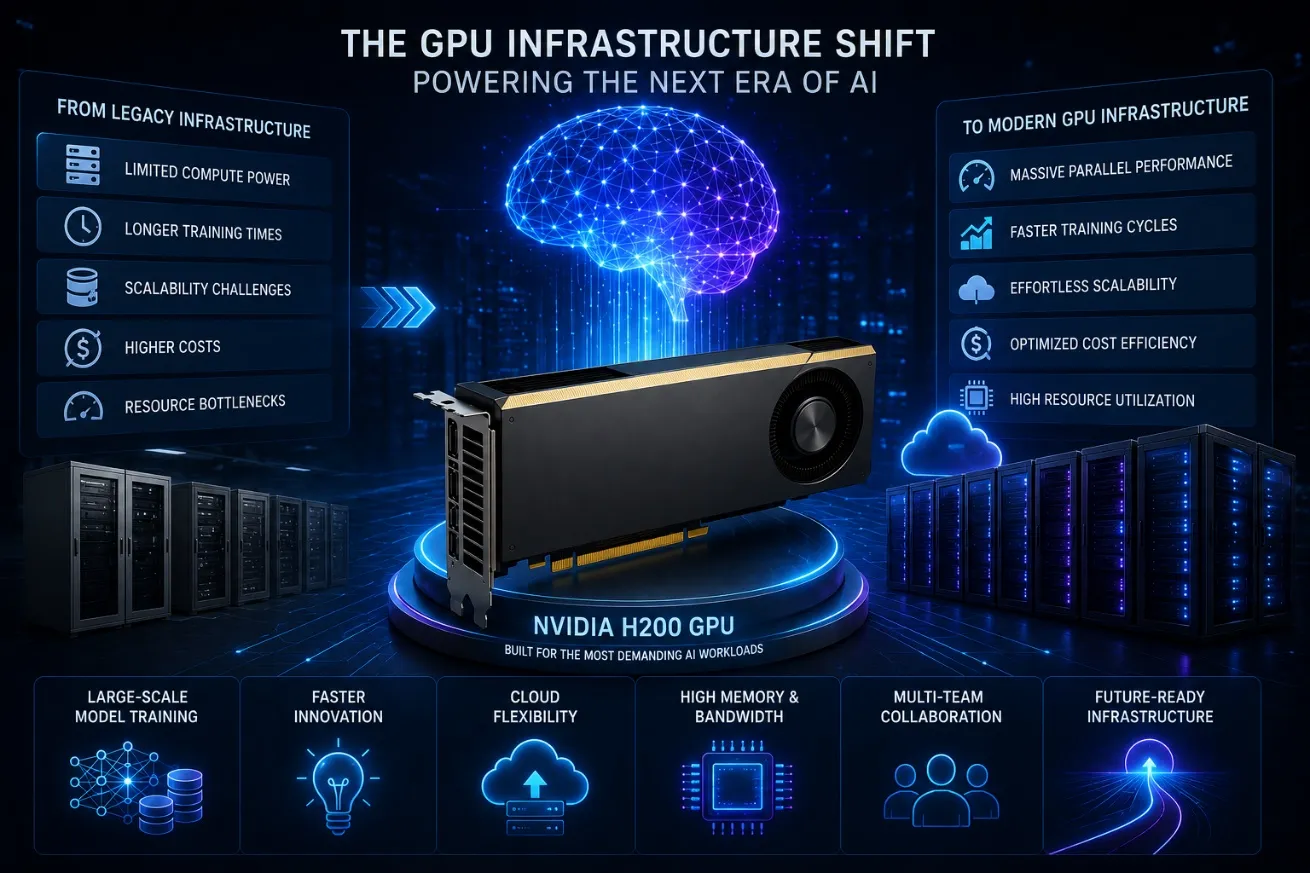
Why Traditional AI Infrastructure Is No Longer Enough
As machine learning matured, initial teams or organizations often depended on small clusters of GPUs, or even only CPUs, for training the models. Although suitable for smaller workloads at first, current machine learning models demand considerably more.
Large language models, generative AI applications, recommendation systems, and multimodal models require massive computational resources. Training these models is computationally very intensive, using very large datasets and millions of parameters, and placing an incredible strain on infrastructure.
As a result, AI teams are moving away from legacy environments and investing in modern GPU infrastructure that can support today’s computational requirements.
The Rise of Large-Scale AI Models
AI models getting bigger is also one of the reasons for the infrastructure move. Many organizations are building more complex systems that need a long training time and high computing capability.
Modern models demand:
-
Larger memory capacity
-
Faster data processing
-
Efficient distributed training
-
Reduced training times
Traditional hardware often becomes a bottleneck under these conditions. The NVIDIA H200 GPU is designed to address these challenges by providing the performance needed for large-scale AI development while maintaining efficiency across demanding workloads.
AI Teams Are Prioritizing Faster Training Cycles
A critical source of competitive advantage in AI is velocity. Companies that are able to train, test, and deploy their models quickly gain a considerable edge over their competitors and accelerate innovation.
Training takes a lot of time. These long cycles result in slow experiments and higher costs. So AI teams are trying to invest in infrastructures that allows models to train fast, without affecting quality.
The NVIDIA H200 GPU supports this objective by enabling faster processing of complex workloads, allowing researchers and engineers to iterate more efficiently and bring AI products to market sooner.
Moving Toward GPU-Centric Infrastructure
A second prominent shift is the move from general-purpose computing infrastructure to GPU-based architectures. Instead of seeing GPUs as “accelerators” and an extra accessory, it is actually central to the infrastructure of how AI runs.
This approach offers several benefits:
-
Improved performance for AI workloads
-
Better scalability for future projects
-
Higher efficiency for parallel processing
-
Reduced training bottlenecks
The NVIDIA H200 GPU logically fits within this transition. These are specifically intended for the high-performance AI and Machine learning applications that need high computational throughput.
Cloud-Based GPU Adoption Continues to Grow
AI teams are also changing how they access computing resources. Rather than investing exclusively in on-premise hardware, many organizations are turning to cloud-based GPU infrastructure.
Cloud deployments provide:
-
Faster access to computing resources
-
Flexible scaling options
-
Reduced infrastructure management
-
Lower upfront capital investment
The NVIDIA H200 GPU can also be rented through cloud providers, so your team has access to serious training hardware without having to house huge GPU farms.
This flexibility is enabling companies to speed up their AI initiatives, with greater control over costs.
The Importance of Memory and Data Throughput
The issue of limited memory becomes more and more important as AI models are becoming complex. The large dataset and complicated architecture require large memory capability and efficient data movement.
A number of AI teams are beginning to favor infrastructure which attempts to reduce such bottlenecks. The NVIDIA H200 GPU is designed to handle large memory-bound workloads with smoother training processes and better efficiency.
This capability is particularly important for organizations working with foundation models, large language models, and advanced generative AI systems.
Supporting Multi-Team AI Environments
These days, in many modern organizations, there are several AI teams in charge of several AI-based projects at the same time. Managing the shared infrastructure has become critical.
Organizations now require GPU environments that can support:
-
Multiple concurrent workloads
-
Research and development projects
-
Production AI systems
-
Scalable resource allocation
The NVIDIA H200 GPU helps organizations build infrastructure capable of supporting diverse AI initiatives while maintaining performance across teams and workloads.
Infrastructure Decisions Are Becoming Strategic
AI infrastructure is now more of a strategic business decision, and no longer simply a technical one that drives innovation, productivity, and competitive advantage.
Organizations are evaluating infrastructure based on:
-
Training efficiency
-
Scalability
-
Resource utilization
-
Long-term growth potential
Since AI plays a key role in business operations, high-performance GPU infrastructure is perceived more like a future growth investment rather than an operating expense.
Preparing for the Next Generation of AI
The current transition in infrastructure isn’t just for what is necessary today. The AI teams are preparing for future loads that will have an even greater computational need.
These technologies, such as automated systems, higher levels of reasoning, multi-modal AI, and real-time intelligent systems, will be additional burdens on computing.
Organizations that adopt scalable GPU infrastructure today will be better positioned to support future innovation. With changing requirements in AI due to advances in technology, NVIDIA H200 GPU delivers the power and flexibility required.
Conclusion
This ongoing GPU infrastructure shift occurring among AI teams mirrors the expanding role and increasing complexity of modern artificial intelligence. Large-scale AI training, inference, and deployment, etc. Are becoming too large for the conventional computing environment.
Training cycles are accelerating, and companies are looking to scale up their AI operations and do so more efficiently. Complex technologies like the NVIDIA H200 GPU are taking front stage in AI infrastructure strategies. Businesses are reshaping the core of their AI functions as cloud deployments, GPU-centric infrastructures, and the massive development of models.
The teams that embrace this shift today will be better equipped to innovate, scale, and compete in the increasingly AI-driven future.
